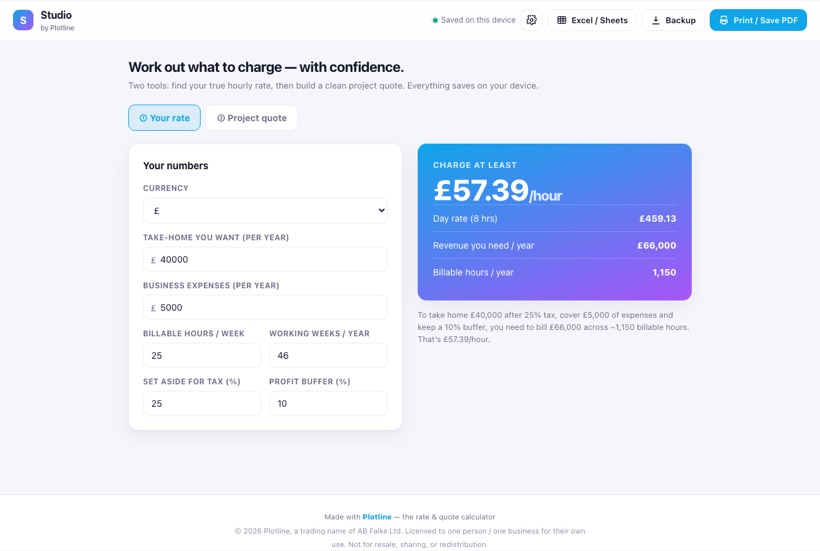
Start with the income the business needs to generate
Write down the annual amount you want available to pay yourself, then add your business expenses: software, equipment, insurance, accounting and other running costs. Be consistent about which costs you include so you don't count them twice.
This gives you a starting revenue requirement, not a guaranteed take-home figure. Personal and business taxes depend on your circumstances. If you begin with an after-tax income goal, you will need an appropriate tax allowance as well; the simple example below is before personal income tax.
Count the hours you can actually invoice
A 40-hour working week does not automatically mean 40 hours you can charge to clients. Proposals, bookkeeping, finding work, training and unpaid revisions all use time.
- Start with the weeks you expect to work after holidays and other time away.
- Estimate how many hours per week can realistically be billed.
- Multiply the two to get annual billable hours.
If you already freelance, look at recorded time rather than relying only on your ideal week. If you are starting out, test a cautious scenario as well as your hoped-for workload.
A worked example
These are hypothetical figures to show the arithmetic, not a recommended rate or tax estimate.
- Annual amount for owner pay, before personal tax
- £36,000
- Annual business running costs
- £6,000
- Revenue requirement
- £42,000
- Working weeks × billable hours per week
- 46 × 25 = 1,150 hours
- Starting hourly rate
- £36.52
£42,000 ÷ 1,150 is about £36.52 an hour. At 35 billable hours across the same 46 weeks, the arithmetic would be about £26.09. That difference is why your realistic billable time matters.
Neither figure includes a separate contingency or profit target above the stated owner pay and expenses. Add those to the revenue requirement if you want them covered. Rounding a starting rate is a commercial decision; the calculation does not tell you what a buyer will pay.
Turn it into a day rate or project quote
For a day rate, define how many billable hours a day includes. Six hours at the example's unrounded hourly rate is about £219.13. Avoid quoting an eight-hour day if the price only covers six.
For a fixed-price project, estimate all the delivery time, including preparation, meetings and the revisions you agree to provide. State the scope and what happens when it changes. An hourly calculation is a useful floor to investigate, not a substitute for checking the value, risk and demand for the work.
Try the calculation before buying a tool
The Plotline Freelance Rate Calculator is a downloadable browser app for working through hourly and day rates and project quotes. Open the demo and check whether the workflow fits how you price work. The Etsy listing explains the download and current offer.
This guide explains a calculation, not personalised financial or tax advice. No result guarantees demand, bookings or income. Example checked 28 October 2026.